clanak, kritika / 21.03.2011.
What Lipovac Means to Us and What We Mean to Him
Transcript and record text
DOWNLOAD DOCUMENT
SUMMARY
An essay and critical review by prominent art historian and critic Ive Šimat Banov published in the weekly magazine Aktual (No. 4, 21 March 2011) on the occasion of the Open Studio Days of Vasko Lipovac. The event commemorated the 80th anniversary of birth (1931) and the 5th anniversary of the passing (2006) of the great artist. The author reflects on their long friendship and encounters in Lipovac’s Split atelier, exploring the enduring cheerfulness, childlike wisdom, geometric purity, and boundless celebration of life that characterize his oeuvre, while reflecting on the city’s and society’s cultural debt to Lipovac.
ARTICLE TRANSCRIPT
Remembering the Great Artist
What Lipovac Means to Us and What We Mean to Him
Prominent art critic and theorist writes about the Open Studio Days of Vasko Lipovac, marking the 80th birth anniversary and 5th death anniversary of the great artist and longtime friend
By: Ive Šimat Banov
Although A. G. Matoš and, more recently, printmaker and writer Z. Tišljar assure us that the afterlife does not exist among Croats, in Vasko Lipovac’s atelier, it exists once again. For what could one man and one life do more for art, for his city, and, let us say, for his people, than Vasko Lipovac? The world of Vasko Lipovac became intertwined with life through the axiom of naturalness and human humility. A world in which everyone understands everything, everyone recognizes everyone, and in which everyone speaks the same language. I sit for the umpteenth time in this studio, and before me pass anew captains of long and short voyages, sailors, holy women, prelates, old writers, a realm of wise sluggishness, Maruls and Dujams, but behold! also proud women of easy virtue who are not ashamed of their calling, because it is a matter of service and joy of living. Copulative verbs are placed in an aquarium of innocence. Priapus’s problem is rendered innocently and almost virtuously. No sin anywhere! Only a world of curvy and voluptuous ladies. Bed, table, door, bottle-heads and flagon-heads with wide open eyes—all these are props of the everyday holiday that radiates the astonishing glory of daily life; a wondrous universe of customs, tempers, and faces.
My grandfather, excusing our constant companionship, used to say that a man is twice a child in his life and once a man. I observe Vasko Lipovac and how successfully, through his close and intimate, yet never merely private world, he bypassed or skipped that “mature”, manly age, and I think how, much like Riba (Lončarić), Vojo (Radoičić) or Zlatko (Bourek), Lipovac grew up almost against his will. I can imagine the despair of his teacher, the serious Kosta Angeli Radovani, before this entire generation of “innocent philosophers” who grasped the lesson of simplicity and purity of form, but not of the deadly seriousness of life and art. The lesson on the grave solemnity of sculpture Vasko never quite took to heart.
Nor did he ever try, even from childhood, to solve sculptural problems, but rather to diminish the distance between play and duty, pleasure and work. Those boundaries in his oeuvre became completely transparent, because for him, as for all genuine Mediterraneans, the body aged faster than the spirit. Vasko could not harness himself to anything outside his own universe. And the validity of his artistic adolescent credentials never needed verification.
He speaks to me. Relaxed, irreverent, gazing at some angel, a being outside the pack, having no ear for choral singing. He is a being like a goldfinch: first in his family home where bread was baked through the night and dawn, and later here, in the cage of this atelier, humming and weaving his canzoniere of love and passion for life. His task was to turn memory into a form of the present, to close the circle with childhood and within it feast on wantonness and freedom. Everything they call an oeuvre, which will end up where it is least needed (museums, galleries, collections), ought to remain mixed with life’s movements and human steps. For Vasko proves that it is possible to live broadly rather than narrowly, to mock and smile at the deadly seriousness of the world, and not be born in the cramped cradle of specialized art starved by bulimic ideals of fasting and abstinence (the famous “less is more!”), nor indulge in cerebral brooding before so much evidence of divine abundance and life’s miracles. To be right (visually) or to be in time, for him meant being in harmony with himself.
I listen to him. If I say we were friends, I will only be one voice in a mass choir; if I say I sat with him in this space, I will only be one among the multitude that drank in the cheerfulness from his face.
And now he rises, walks away looking for something, and I see the animation of his sculpture. He sits and gets up again, leans over the table and unearths an unusual tool throwing a flame from its tip. He shows me drill bits unlike anything I have seen in a hundred studios. That dentistry can tackle anything: from a baby tooth to an elephant tusk. And always that human exuberance radiating from his whole frame and every movement. None of the pretentious posturing so common in Croatian intellectual circles. He is a character straight out of a wise children’s book where everything is familial and where there are few words, but a feast of pictures.
And so the studio opens; one cannot say without Vasko Lipovac. And while his family pieces together the mosaic of his body and spirit, phrases about works that outlive us feel serious and tangible. It is impossible to see how Vasko Lipovac could die. For if, as Balzac says, “glory is the sun of the dead”, on his grave rests not just a single beam, but an entire bundle of light.
Citation
Ive Šimat Banov. „What Lipovac Means to Us and What We Mean to Him”. Aktual, Aktual, Zagreb, 21 March 2011, No. 4, pp. 60–61. 21.03.2011.. Vasko Lipovac — Bibliography and digital archive. VL-BIB-2011-SIMAT-BANOV-AKTUAL. https://arhiva.vaskolipovac.hr/en/bibliografija/2011-simat-banov-aktual-sto-je-lipovac-nama/
Related records
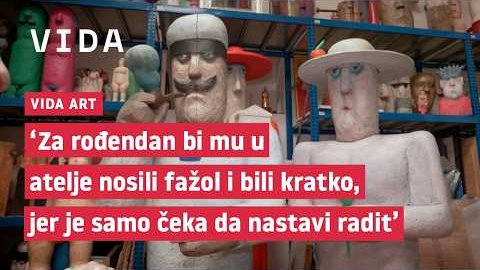
video, tv-show, interview 21.08.2026.
VIDA art - Vasko Lipovac: A World-Class Artist from Split
Video feature and reportage by journalist Branimir Zekić for VIDA art (VIDA TV, August 2026) dedicated to sculptor, painter, and printmaker Vasko Lipovac. The report explores Split’s relationship to the priceless legacy of the modern master, documents the family’s efforts to keep …
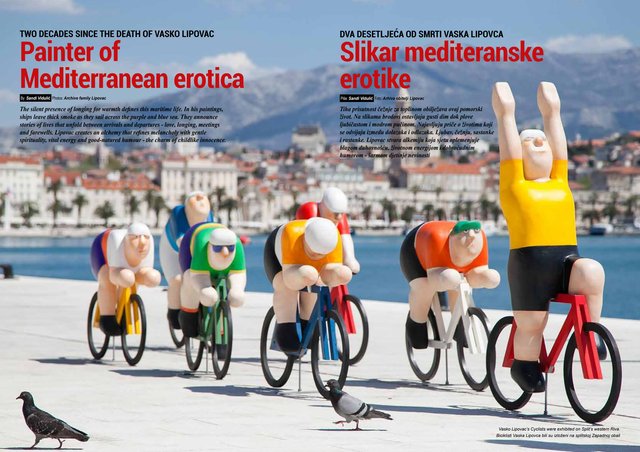
članak, esej, biografija 15.01.2026.
Painter of Mediterranean Erotica: Two Decades Since the Death of Vasko Lipovac
Comprehensive bilingual (Croatian/English) feature essay and retrospective survey by journalist and art historian Sandi Vidulić, published in the official luxury edition Visit Split by the Split Tourist Board (2026) commemorating two decades since the death of Vasko Lipovac …
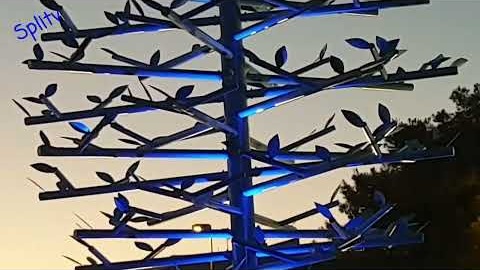
video, short-film 02.02.2022.
The Blue Tree: Vasko Lipovac in the Park by Dom Mladih in Split
Short video clip by the Split video portal Splitv capturing the presence of Vasko Lipovac’s monumental public sculpture “The Blue Tree” (Plavo stablo) in the park next to Dom Mladih and the HRT building in Split (Ulica slobode). The footage showcases the harmonious interplay …